

New to Quarterzip? Be sure to visit the Getting Started page before continuing with this section.
Quickstart Plan
- Configure your Quarterzip Workspace for SDK
- Install the Quarterzip SDK
- Grant Security Permissions
- Trigger the Quarterzip Agent
Configure your Quarterzip Workspace for SDK
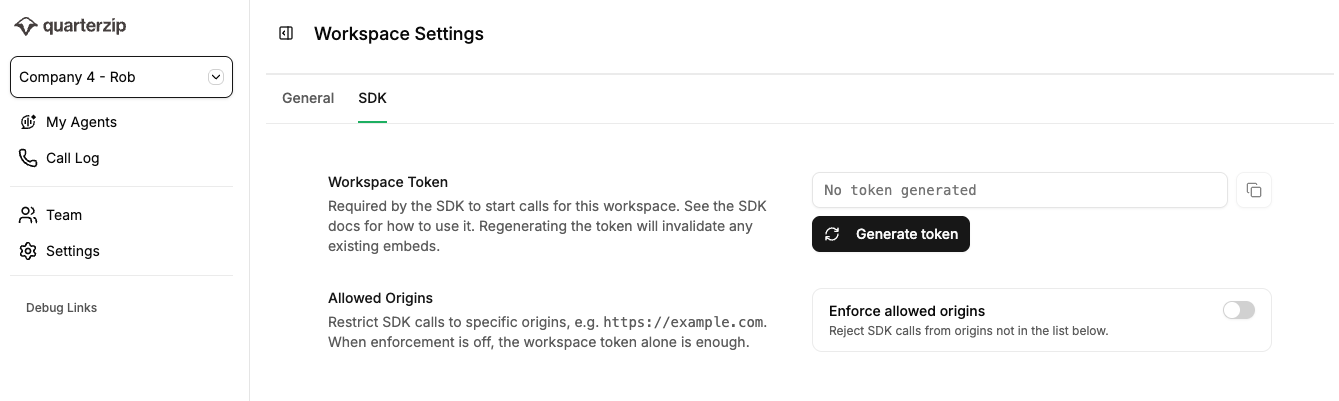
Visit the SDK Settings (Settings -> SDK) in your Quarterzip workspace. This page provides the configuration options to restrict who may serve your agent on your behalf.
- Workspace Token: a public token used to authenticate your site to Quarterzip.
- Allowed Origins: an optional list of site origins that are authorised to serve your Quarterzip agent. This list may include wildcards for subdomains, i.e.
https://*.example.com
- Agent ID: A 6 alpha-numeric character ID to identify your agent. Select the menu button in the top right and click share my agent. From here, the agent_id is the 6 alpha-numeric characters at the end of the url, after the
/d/.
Install the Quarterzip SDK
CDN Script
NPM Package
Grant Security Permissions
The Quarterzip SDK operates in a security sandbox separate from your site. In order for your Quarterzip agent to communicate with your users, the following permissions must be granted if enforced.CSP requirements
Only relevant if your page sends aContent-Security-Policy header, then it must permit Quarterzip’s SDK origin to be framed.
Permissions Policy
Only relevant if your page sends aPermissions-Policy header, then it must permit Quarterzip’s SDK origin the following permissions:
Trigger the Quarterzip Agent
Callwindow.Quarterzip.open() from any user interaction; i.e. a button-press. Visit SDK API Reference for more details.
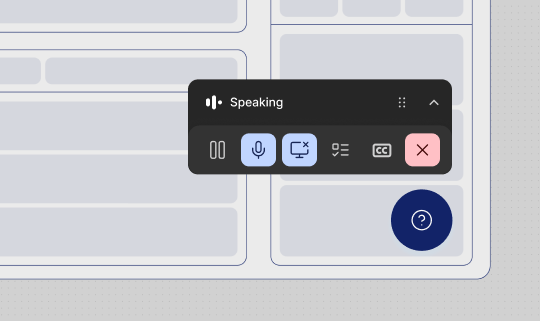
The Help icon button calls window.Quarterzip.open() on user interaction.
Best Practices
Set yourself up for success.
Webhooks
React and receive call data.
Advanced patterns
Passing additional context to the agent
Thecontext parameter may be used to provide additional information to the agent to enhance the conversation; e.g. the user’s plan, country, or handover notes from another support tool. The agent only receives this information if the user decides to start the call. The amount of context is capped at 2,000 characters.
Conditionally present Quarterzip agents
Most customers prefer to show agents to users based on feature-flags or user-attributes. Screen-sharing requires the user’s browser to have thegetDisplayMedia() web API, which is unavailable on most mobile devices and can help determine which users to filter out.
Closing on route change
End the call when a user navigates away from a specific area (React Router v6 example):React wrapper hook
What’s Next?
Best Practices
Set yourself up for success.
Webhooks
React and receive call data.